
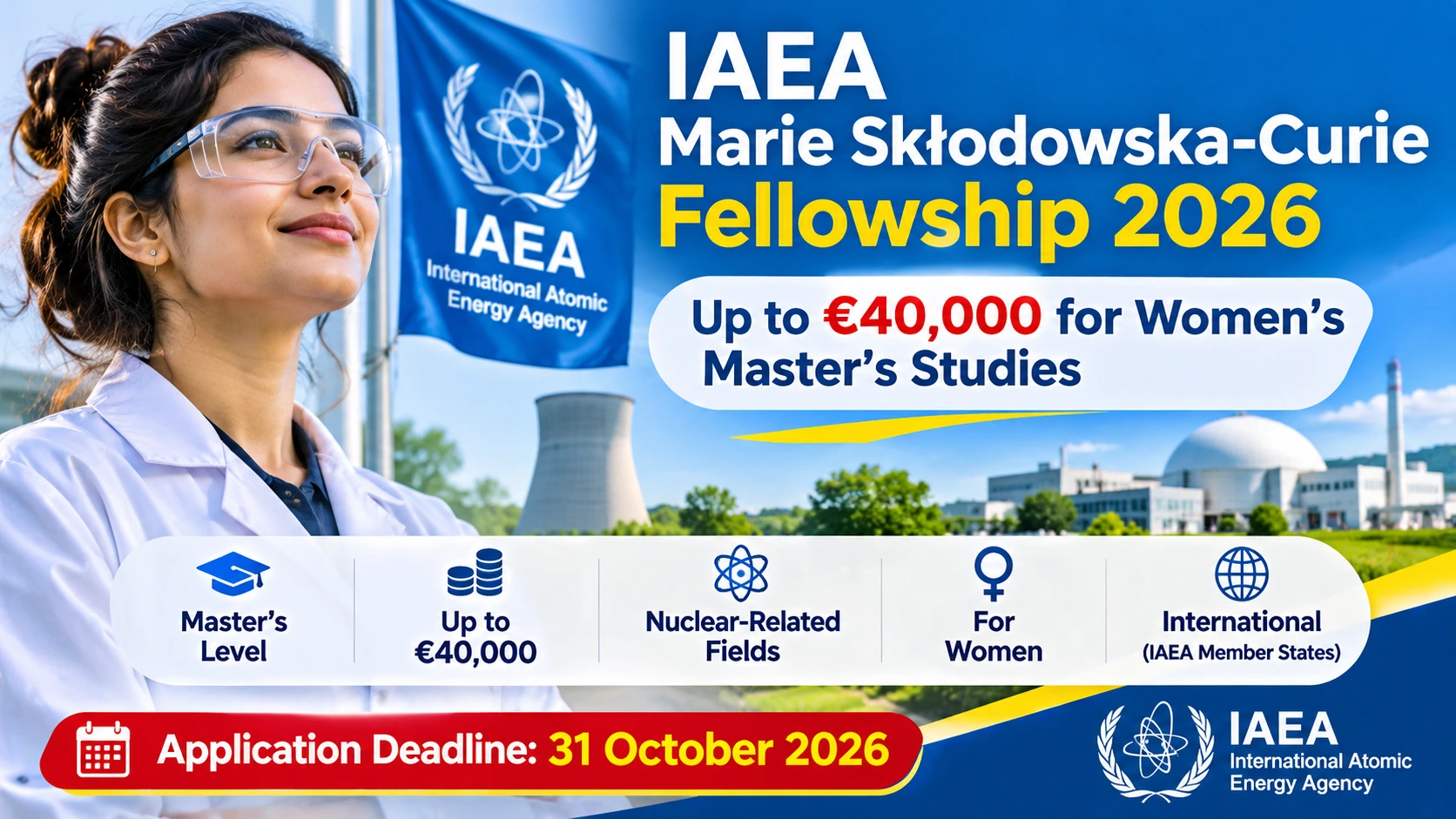
IAEA Marie Skłodowska-Curie Fellowship 2026: Up to €40,000 for Women’s Master’s Studies

Last Updated: 25 October 2026
Host Organisation: International Atomic Energy Agency (IAEA)
Scholarship Level: Master’s Degree
Eligible Applicants: Women from IAEA Member States
Field of Study: Nuclear-related disciplines
Scholarship Value: Up to €40,000 in total support, subject to programme conditions
Application Deadline: 31 October 2026
Official Application: https://www.iaea.org/services/key-programmes/iaea-marie-sklodowska-curie-fellowship-programme
Overview of the IAEA Marie Skłodowska-Curie Fellowship
The IAEA Marie Skłodowska-Curie Fellowship Programme (MSCFP) supports women pursuing Master’s degrees in nuclear-related fields at accredited universities.
Established by the International Atomic Energy Agency, the programme aims to encourage more women to build careers in nuclear science, technology and related disciplines.
The fellowship is an opportunity for eligible international students who are already accepted into, or enrolled in, a qualifying Master’s programme.
For the 2026 application cycle, eligible candidates should review the requirements and prepare their applications before the 31 October deadline.
Scholarship Benefits
Selected students may receive financial support for their Master’s studies.
The programme offers:
- Tuition support: Up to €20,000 for tuition costs.
- Living expenses: Up to €20,000 toward living costs.
- Potential internship opportunities: Selected fellows may have access to internship opportunities facilitated by the IAEA.
- International academic exposure: Opportunities to develop skills in nuclear science and related research fields.
The maximum advertised financial support is up to €40,000 across tuition and living expenses.
This is a funding ceiling, not a guaranteed payment to every student. Actual awards depend on eligible expenses, programme conditions and other scholarships received.
Applicants must disclose additional scholarship funding as required by the programme.
Who Can Apply?
The IAEA Marie Skłodowska-Curie Fellowship has specific eligibility requirements.
1. Nationality
Applicants must be nationals of an IAEA Member State.
The programme is international, and eligible nationalities include candidates from many countries across Africa, Asia, Europe, the Americas and other regions.
Applicants should consult the official eligibility information to confirm their nationality qualifies.
2. Gender Eligibility
The programme is open to female candidates.
3. University Admission
Applicants must be accepted into or enrolled in a Master’s programme at an accredited university.
The degree programme must be related to nuclear studies or another qualifying nuclear-related field.
4. Academic Performance
Preference is given to candidates with strong academic records.
The published eligibility information identifies above-average academic credentials, typically 75% or above or a GPA greater than 3.0 on a 4.0 scale, as preferred.
Candidates should review the current application rules for how academic records are assessed.
Eligible Fields of Study
The fellowship supports nuclear-related academic disciplines, including:
- Nuclear Engineering
- Nuclear Physics
- Nuclear Chemistry
- Nuclear Medicine
- Radiation Biology
- Nuclear Safety
- Nuclear Security
- Nuclear Non-Proliferation
- Isotopic Techniques
- Nuclear Law
Applicants should make sure their chosen degree programme meets the fellowship’s definition of a nuclear-related field.
Application Deadline
The application deadline for the 2026 programme is:
31 October 2026
The deadline is approaching. Candidates should confirm the exact closing time and time zone on the official application platform.
Applicants should also ensure that references and supporting documents are submitted correctly.
Required Application Documents
Applicants should prepare the documents requested by the programme, which include:
- Copy of passport or national identity document
- Official university admission or acceptance letter
- Evidence of the Master’s programme’s tuition costs
- Information about other scholarships, where applicable
- Required reference forms submitted by referees
The application portal may require additional information or documentation.
Review the current checklist before submitting.
How to Apply for the IAEA Fellowship
Step 1: Check the Official Eligibility Requirements
Visit the official IAEA programme website and review the eligibility conditions.
Confirm your nationality, academic programme and university admission status.
Step 2: Prepare Your University Documents
Obtain your official admission letter or enrolment documentation and tuition fee statement.
Make sure the programme title and duration are clear.
Step 3: Prepare Your Application
Complete the required application information and prepare your supporting documents.
Use accurate information throughout the application.
Step 4: Arrange Your References
Contact your referees early.
The programme requires reference materials to be submitted according to its instructions. Make sure your referees understand the deadline.
Step 5: Submit Your Application
Apply through the official IAEA recruitment and fellowship application system.
Official application information:
Application portal:
https://iaea.taleo.net/careersection/mscfp/jobsearch.ftl?lang=en
Step 6: Monitor Your Application
Keep checking your application account and email for updates, requests for additional documentation and selection announcements.
Can Students Apply Before Receiving University Admission?
The programme requires applicants to have been accepted into or enrolled in an accredited Master’s programme in a nuclear-related field.
Students who have not yet secured admission should first review the current programme rules and university admission timelines.
Do not assume that submitting a fellowship application automatically secures university admission.
Frequently Asked Questions
Is the IAEA Marie Skłodowska-Curie Fellowship fully funded?
The programme provides up to €20,000 toward tuition and up to €20,000 toward living costs. Actual support depends on eligibility, approved expenses and funding conditions.
Can international students apply?
Yes, eligible women who are nationals of IAEA Member States may apply, subject to the programme requirements.
Is this fellowship available for Bachelor’s or PhD degrees?
This fellowship supports Master’s studies. It is not a general Bachelor’s or PhD scholarship.
Is IELTS required?
Language requirements depend on the university and degree programme. Applicants should verify the admission requirements of their selected institution and the fellowship instructions.
Does the fellowship guarantee an internship?
No. Internship opportunities facilitated by the IAEA are limited and competitive. Applicants should not assume that every fellow receives an internship.
Is there an application fee?
Consult the official application instructions for the current process. Applicants should use the official IAEA application platform and avoid unofficial agents claiming guaranteed awards.
Final Thoughts
The IAEA Marie Skłodowska-Curie Fellowship offers a valuable oppo
Related scholarships and guides
- Open Doors Russian Scholarship 2026/27: Tuition-Free Study for International Students
- France Excellence Pakistan Climate Change Scholarship 2027: Fully Funded Master’s in France
- World Bank Scholarships 2027: Fully Funded Master’s Opportunities for Students from Developing Countries
- University of Sydney Vice-Chancellor’s International Scholarships 2027


One Comment