
Personal Statement & Documents for Scholarship Applications
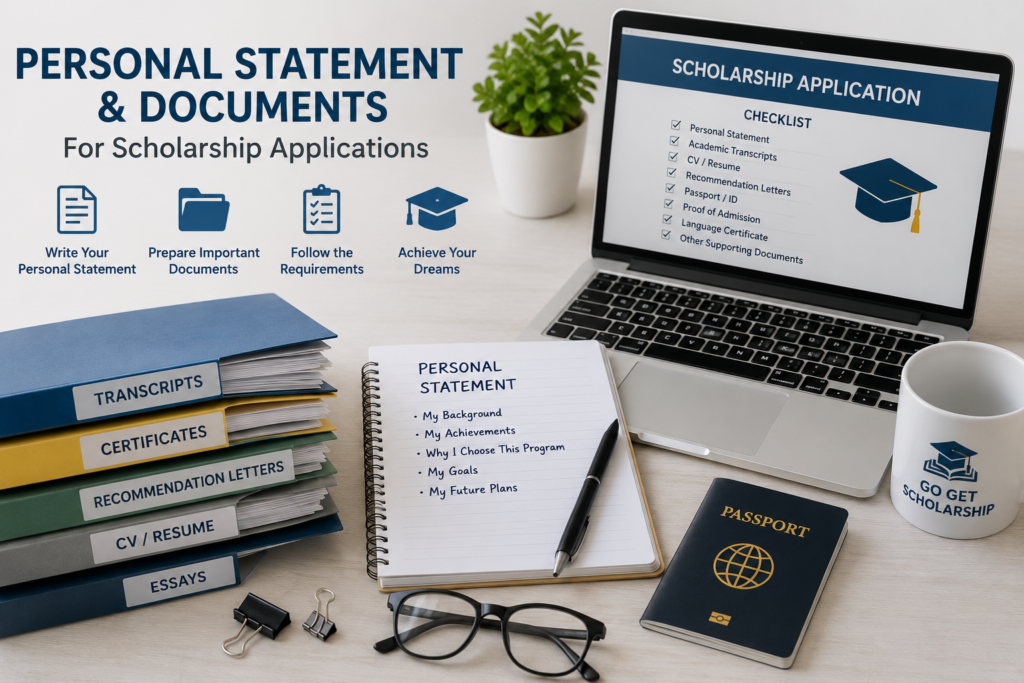
A strong scholarship application is more than completing an online form. Many scholarships require important documents such as a personal statement, academic transcripts, CV, recommendation letters, identification documents, and other supporting materials.
Preparing these documents early can help you submit a more complete and organized application.
What Documents Do You Need for a Scholarship?
The required documents depend on the scholarship, university, degree, and country. Common documents may include:
- Personal statement
- Statement of purpose
- Scholarship essay
- Academic transcripts
- Degree or qualification certificates
- CV or resume
- Recommendation letters
- Passport or identification document
- Proof of English-language proficiency
- Proof of admission
- Portfolio or examples of work
- Research proposal for some postgraduate programs
Always check the official scholarship or university website for the exact requirements.
How to Write a Strong Personal Statement
A personal statement gives the scholarship committee an opportunity to understand your background, goals, motivation, and achievements.
A good personal statement should explain:
1. Your Academic Background
Briefly describe your education, academic interests, and relevant achievements.
2. Your Goals
Explain what you want to achieve through your education and how the scholarship can support your future plans.
3. Why You Chose the Program
Explain why the particular course, university, or field of study is important to you.
4. Your Experience and Achievements
Include relevant academic, professional, volunteer, leadership, or extracurricular experience.
5. Your Future Plans
Show how your education can contribute to your career and long-term goals.
Tips for Writing a Scholarship Personal Statement
Keep your statement clear, honest, and specific.
- Answer the question directly.
- Use real examples from your experience.
- Avoid unnecessary repetition.
- Follow the required word limit.
- Explain your goals clearly.
- Proofread carefully before submitting.
- Customize your statement for each scholarship.
- Do not copy another student’s personal statement.
Your personal statement should represent your own experiences, achievements, and goals.
Preparing Your Academic Documents
Academic transcripts and certificates are commonly requested during scholarship and university applications.
Before applying, make sure your documents are:
- Clear and readable
- Complete
- Correctly named
- In the required format
- Translated if required
- Certified or verified if requested
Keep digital copies of your important academic documents in a secure folder so they are easy to access when applications open.
Recommendation Letters
Some scholarships require one or more recommendation letters.
Choose someone who knows your academic, professional, or extracurricular work well, such as:
- University professors
- Teachers
- Academic supervisors
- Employers
- Professional supervisors
Give your recommender enough time to prepare the letter and provide them with useful information about the scholarship and your goals.
Create a Scholarship Documents Checklist
Before submitting an application, check whether you have everything required.
☐ Personal statement
☐ Scholarship essay
☐ CV or resume
☐ Academic transcripts
☐ Degree certificates
☐ Recommendation letters
☐ Passport or ID
☐ Language certificate
☐ Proof of admission
☐ Additional documents requested by the provider
Not every scholarship requires all of these documents.
Important: Always Check the Official Requirements
Scholarship requirements can change between programs and application cycles.
Before submitting your application, visit the official scholarship provider or university website and confirm:
- Required documents
- Word limits
- File formats
- Application deadline
- Eligibility requirements
- Translation or certification requirements
- Submission instructions
Do not rely solely on information shared through social media or third-party websites.
Final Thoughts
Preparing your scholarship documents early can make the application process much easier. Start by creating a checklist, organize your academic records, prepare a strong personal statement, and give recommendation providers enough time to write their letters.
Most importantly, make sure every document is accurate and follows the official application instructions.
Explore our scholarship guides to learn more about finding scholarships, writing applications, and preparing for study abroad opportunities.